An equity waterfall is the set of rules that decides who gets paid what, and in what order, when a real estate investment distributes cash. The promote is the outsized share the sponsor earns once the investors have been paid an agreed return. Between them they determine how a deal’s profit is actually divided, and they are the part of a structure most often summarised in a single line and least often understood in detail.
Why a waterfall exists at all
In most real estate investments, one party puts up the majority of the capital and another party sources the deal and runs the business plan. The limited partners, typically institutions, funds or private investors, provide the equity. The general partner, or sponsor, originates the transaction, executes the asset management, and usually invests a smaller amount alongside.
A flat pro-rata split would pay the sponsor in proportion to a small cheque, regardless of performance. A waterfall solves that by paying investors first up to an agreed threshold, then shifting a disproportionate share of everything above it to the sponsor. The sponsor is rewarded for outperformance rather than for showing up.
The tiers, in order
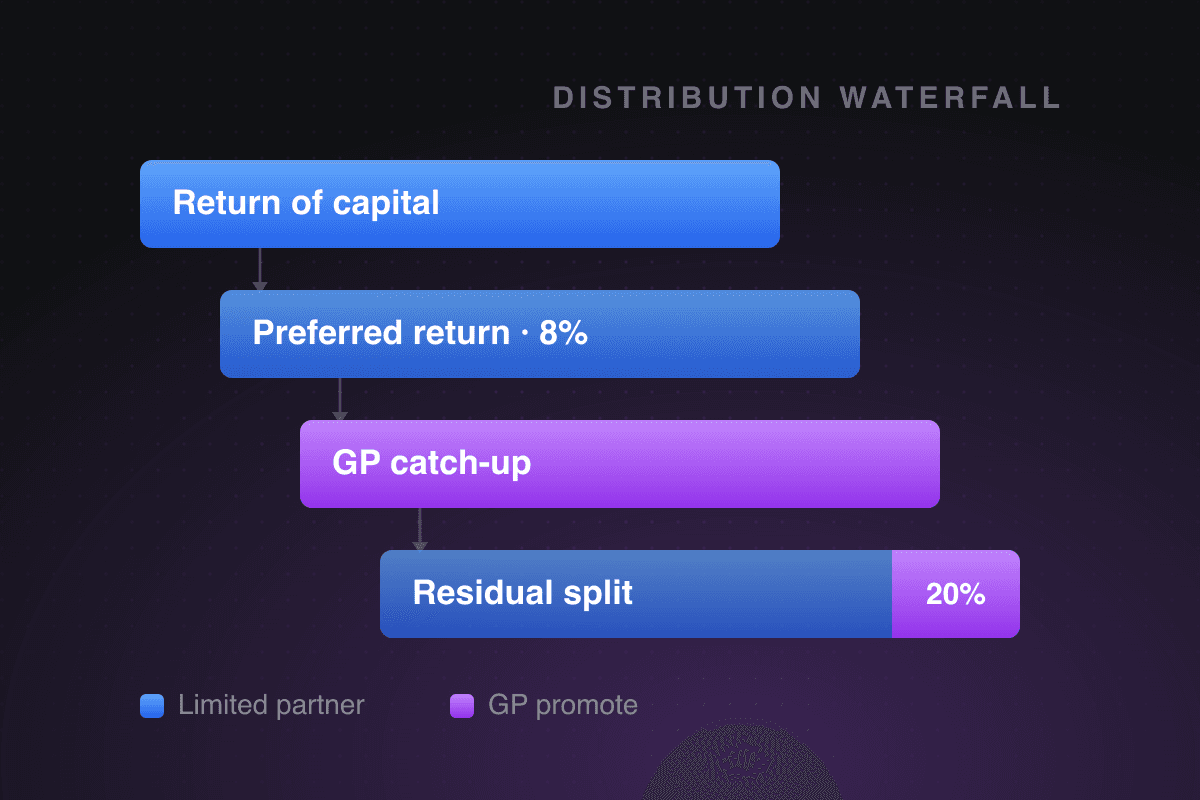
Return of capital
Distributions first repay the limited partners their contributed capital. Nothing further happens until investors are whole on the money they put in. Some structures return capital before the preferred return, others after; the order matters more than it sounds, because it changes when the sponsor starts participating.
The preferred return
The next tier pays investors a minimum return on their capital, commonly quoted between 7% and 10% per annum. This is the “pref”. It is not a guarantee and it is not interest. It is simply a priority claim: no promote is paid until it has been met.
The critical detail is how it accrues. A compounding pref rolls unpaid amounts forward and charges a return on them; a simple pref does not. Over a long hold with back-ended cashflow, the difference between the two is substantial.
The catch-up
Many structures then include a catch-up tier, where the sponsor receives all or most of the distributions until it has earned its target share of total profit. A full catch-up means the sponsor ends up with exactly its promote percentage of all profit above the return of capital, not just of the profit above the pref.
Not every deal has one. Its presence, and whether it is 100% or partial, moves real money.
The residual split
Everything remaining is split between the limited partners and the sponsor at the promote ratio, commonly 80/20. This is the tier people mean when they describe a deal as “eighty twenty”.
Multi-tier waterfalls and IRR hurdles
More sophisticated structures stack several promote tiers, each triggered by a higher hurdle. The sponsor’s share increases as performance improves.
| Hurdle | LP share | GP share |
|---|---|---|
| Up to 8% IRR | 100% | 0% |
| 8% to 12% IRR | 80% | 20% |
| 12% to 18% IRR | 70% | 30% |
| Above 18% IRR | 60% | 40% |
The hurdles themselves can be defined in more than one way, and the choice materially changes the outcome. An IRR hurdle is time-sensitive: a quick exit clears it easily, a slow one may never clear it however profitable the deal. An equity multiple hurdle ignores time entirely, so a long hold that eventually doubles investors’ money pays the promote regardless of how long it took.
Many structures require both, precisely because each one on its own can be gamed by timing.
Where the detail actually lives
Two deals can both be described as “8% pref, 80/20 with a full catch-up” and pay materially different amounts. The variables that decide it are rarely in the summary:
A waterfall is not a percentage. It is an ordered set of rules, and the order is where the money is.
Why this is hard to model in a spreadsheet
Waterfalls are iterative. The promote depends on the IRR, the IRR depends on the distributions, and the distributions depend on the promote. Solving that in Excel usually means circular references, iterative calculation switched on, and a model that few people other than its author can audit.
Add a catch-up tier, a compounding pref, a clawback and a mid-life refinancing, and the number of ways to get it subtly wrong grows quickly. The errors are rarely obvious, because a broken waterfall still produces a plausible-looking number.
How Pantera models it
Pantera treats the waterfall as a first-class part of the model rather than a bolt-on. Tiers, hurdles, pref accrual basis, catch-ups and promote splits are defined explicitly, and the resulting distributions are calculated period by period alongside the rest of the cashflow.
Because the structure is modelled rather than hard-coded into formulas, you can see each tier fill in sequence, trace any distribution back to the rule that produced it, and test what a different hurdle or accrual basis does to both sides of the split before it is agreed.
Final thought
The headline split tells you very little on its own. The pref basis, the hurdle definitions, the catch-up and the order of the tiers decide what a deal is actually worth to each party.
If you cannot show which tier a pound came out of, you do not yet know what the structure pays.