Equivalent yield is one of the most widely used valuation metrics in commercial real estate across the UK and Ireland. Despite being a foundational concept for valuers, agents and investors, it is still often misunderstood outside the profession. This article explains what equivalent yield means, why it matters, how it is calculated in practice, and how Pantera brings a new level of clarity to the calculation.
What is equivalent yield?
Equivalent yield represents the single discount rate that, when applied to a property’s future income stream, produces its current capital value.
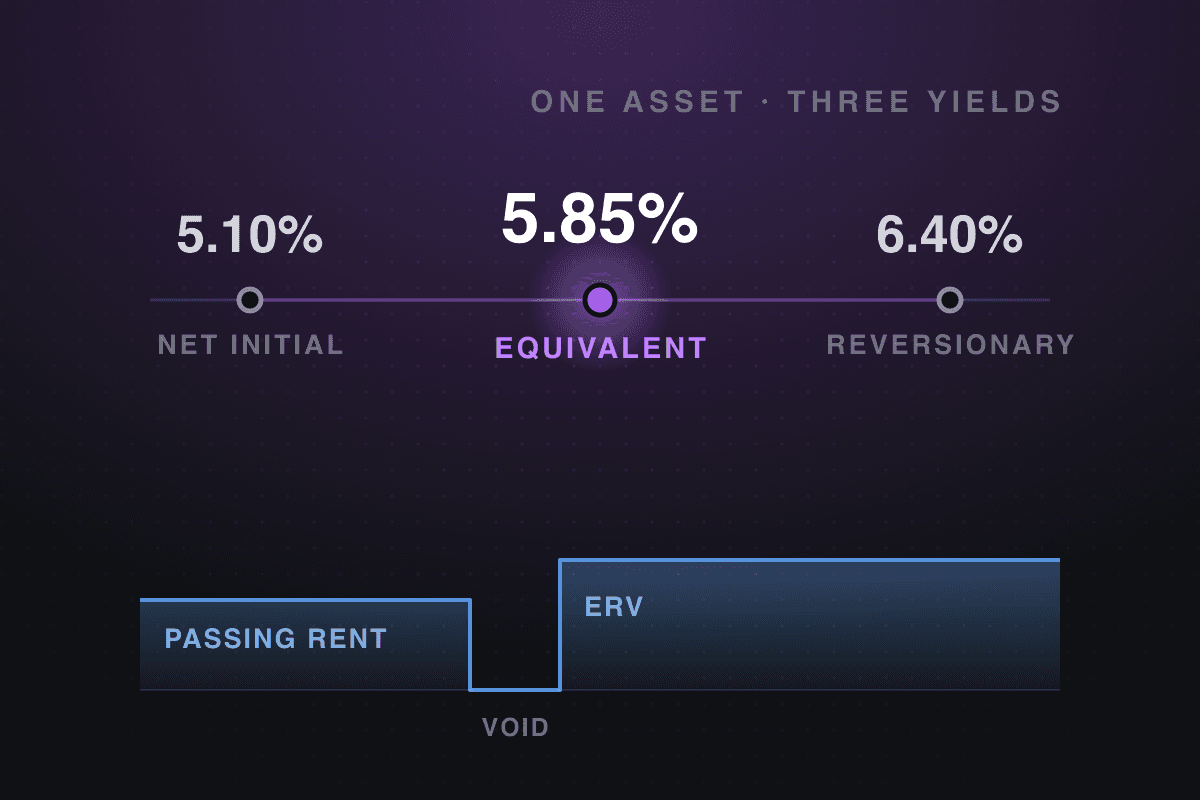
In simpler terms, it blends today’s passing income with tomorrow’s market-level income, the ERV, and expresses the relationship as a long-term return.
How it compares to other yield measures
Analysts usually consider three complementary yields. Net initial yield is based on current passing rent, a snapshot of return today. Reversionary yield is based on market rental value once leases roll to ERV. Equivalent yield typically sits between the two, reflecting the transition from secure income at passing rent to fully reversionary income.
That makes it a balanced measure, accounting for both current performance and future potential.
Why is equivalent yield useful?
Unlike IRR-style cashflow models, equivalent yield remains especially prevalent in the UK and Ireland, where the valuation community favours a blend of assured and reversionary income to arrive at capital value.
Nominal vs true equivalent yield
There are two versions of equivalent yield, both based on the same underlying rent stream but with different payment timing assumptions.
Nominal equivalent yield
Assumes rent is paid in arrears, at the end of a period. It is the version most commonly quoted, because historic comparable evidence is collected on this basis, agency and valuation templates standardise around arrears assumptions, and it is embedded into most professional training, manuals and lender methods.
True equivalent yield
Assumes rent is paid in advance, meaning income arrives earlier. Because of this timing shift, the present value of the rent stream increases and the discount rate required to match capital value is slightly lower. The variation can become meaningful on short income or heavy turnover portfolios.
Understanding which basis is being used is essential when comparing yields between assets.
Why equivalent yield is hard to calculate in practice
Textbook examples typically show a single-tenant building, with a rent stream, a void, and a re-letting back at ERV. Real buildings are rarely that simple. In a multi-let asset, each unit may have:
Blending all of that into a single discount rate manually is slow, error-prone and extremely difficult to audit, which is why valuers lean on software.
A unit-by-unit breakdown
Pantera shows the full calculation rather than just the final result. In a multi-let building, each unit contributes differently based on its rent, expiry, void and ERV position, and the model exposes all of it: passing rent, effective or headline rent, lease term remaining, assumed void period, ERV achieved thereafter, NPV of assured versus reversionary income, and the capital value contribution per unit.
That transparency is extremely useful for valuation justification and client reporting.
Over-rented units and reversionary impact
Some units are over-rented, meaning the passing rent is above ERV. When these leases expire, income drops to ERV, reversionary NPV falls, and the capital value contribution declines. Equivalent yield expresses this numerically, helping analysts quantify how much income risk is embedded in the current rent roll.
Effective rent and rent free adjustments
Some units show an effective rent rather than the headline passing rent. This reflects the structure of the leases: built-in rent free periods that apply when break clauses are ignored. Pantera calculates the blended rent, applies the correct timing, and shows the breakdown on hover, so the model does not hide free rent or incentive effects. It explains them.
Extending the void: rent free assumptions on re-let
Another modelling nuance is the treatment of incentives on new lettings. Many valuers assume the tenant will leave at expiry, that a void will occur, that ERV is not achieved immediately, and that a rent free period applies before full rent resumes. These assumptions shift cashflows further into the future, reducing present value, ERV NPV and the resulting equivalent yield. Software makes these iterative assumptions manageable, repeatable and visible.
Why this helps valuers work with confidence
Equivalent yield remains a powerful and widely used metric, but it is also highly sensitive to timing, lease structure and income profile assumptions. Where many valuation tools output only the final number, Pantera goes further:
For teams training graduates, onboarding new hires, or defending valuation conclusions to investment committees or lenders, this level of visibility matters. Pantera does not replace professional judgement. It supports it by showing exactly where the numbers come from.
Final thought
Equivalent yield sits at the heart of commercial property valuation across the UK and Ireland. Whether assessing a simple lease or a ten-unit office, the logic is the same: today’s rent versus tomorrow’s market reality.
Understanding why the equivalent yield is what it is can be just as valuable as the figure itself.