An investment can generate a 15% IRR, but that does not necessarily mean every investor in the deal earns 15%. Where multiple equity partners invest together, the cash generated by the investment often passes through an equity waterfall. The waterfall determines how much cash each party receives, in what order, and how that split changes as the investment performs.
Three concepts sit at the centre of many of these structures: preferred returns, catch-ups and promotes.
They are often summarised in a few numbers, such as an 8% preferred return followed by a 20% promote. But those numbers only tell part of the story. The sequencing of the waterfall can be just as important as the percentages themselves.
What is an equity waterfall?
An equity waterfall is simply a set of rules for distributing cash between the equity investors in a deal.
Imagine two parties invest in an asset:
The simplest structure would distribute every pound received from the investment 90/10. But many joint ventures do not work like that.
Investor B may also be responsible for sourcing the opportunity, executing the business plan and managing the asset. The parties can therefore agree that Investor B receives an additional share of the profits if the investment performs above certain return thresholds.
The waterfall establishes those thresholds and determines how the cash is distributed as each one is reached.
What is a preferred return?
A preferred return, commonly shortened to a pref, gives one or more investors priority over distributions until an agreed return has been achieved.
Suppose an investor has an 8% preferred return. Rather than immediately distributing available profits according to the ordinary equity split, distributions are first directed towards that investor until the relevant cash flows produce the agreed 8% return.
Importantly, a preferred return is not necessarily the same thing as interest on a loan. The investor remains an equity investor and the precise economic effect depends on how the waterfall has been agreed. The pref simply determines who has first claim on distributions at that stage of the waterfall.
This distinction matters because the term preferred equity is sometimes used to describe something much closer to a separate, senior layer of capital. That structure can have different rights around capital repayment, priority, security and downside protection. A preferred return within an equity waterfall does not automatically mean the investment has those characteristics.
What happens after the preferred return?
This is where waterfalls become more interesting. Once the preferred return has been satisfied, the next pound of distributable cash has to go somewhere. Depending on the agreement, it might:
The order matters. Two investments can therefore have the same equity split, the same preferred return and the same headline promote percentage while producing different investor-level returns.
What is a catch-up?
A catch-up is an intermediate stage of the waterfall designed to change how distributions are allocated after the preferred return has been reached. There is no single catch-up structure used across every real estate transaction.
One common structure is a GP or sponsor catch-up. Once the investor has received its preferred return, a greater share, sometimes 100%, of subsequent distributions goes to the sponsor until the sponsor has caught up to an agreed share of the profits.
But that is not the only way a catch-up can work. Another approach is to use the catch-up to equalise returns between different equity participants before the normal sharing arrangement or promote begins.
For example, if one investor has received distributions first to achieve an 8% preferred return, subsequent distributions can be directed towards the other investor until the wider equity stack has reached the same return threshold. Only after that point does the waterfall move into its next stage.
This distinction is important whenever someone describes a structure simply as having an “8% pref with catch-up.” The obvious next question should be:
Who is catching up to whom?
What is a promote?
A promote is an additional share of profits awarded to one or more parties once an investment has achieved an agreed level of performance. It is commonly used to align the economics of an operating partner or sponsor with the performance of the investment.
Suppose two parties own an investment 90/10. Before the promote hurdle is reached, £100 of distributable cash might therefore be allocated:
Above the agreed hurdle, Investor B might receive a 20% promote.
The important point is that the promote is generally additional to Investor B’s ordinary participation as an equity investor. The economics are therefore not simply “80% to Investor A and 20% to Investor B” unless the agreement specifically says so. The sponsor can continue receiving its ordinary return on invested equity while also receiving its promote from the relevant band of profits.
Promote tiers
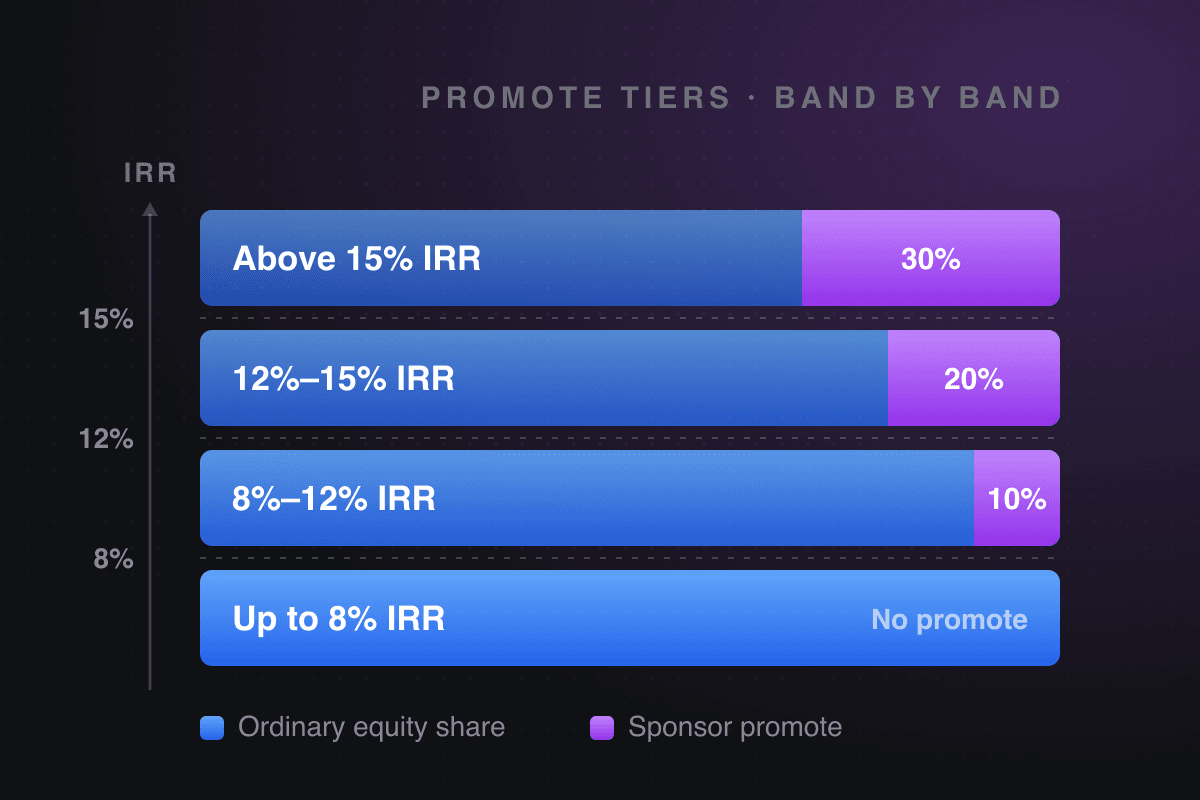
A waterfall does not have to stop at one hurdle. More sophisticated structures often increase the sponsor’s participation as returns improve. A simplified structure might look like this:
| Performance | Promote |
|---|---|
| Up to 8% IRR | No promote |
| 8%–12% IRR | 10% promote |
| 12%–15% IRR | 20% promote |
| Above 15% IRR | 30% promote |
Each tier applies only to the relevant band of distributions. Crossing a 15% hurdle therefore does not usually mean that every pound of profit generated since acquisition is suddenly subject to a 30% promote.
Instead, the waterfall fills progressively. The first layer of cash satisfies the earlier hurdle. The next layer is distributed according to the first promote tier. Further distributions eventually clear the next hurdle and enter the next promote tier.
Thinking about the structure as a series of bands is often much easier than thinking about it as a single formula.
What can the hurdles be based on?
IRR is perhaps the most familiar hurdle, but it is not the only way to structure a promote. A hurdle could be based on:
The distinction can materially affect when a promote becomes payable. Consider an investment that returns 1.5x the original equity. If that happens in two years, the IRR is very different from achieving exactly the same multiple over ten years.
An equity multiple hurdle treats those outcomes equally. An IRR hurdle does not. That is why some structures require more than one test to be satisfied before moving into the next tier.
Timing matters
Waterfalls become particularly difficult because the calculation is not necessarily performed once at the end of an investment. Cash may move in both directions throughout the hold period. There could be:
Each event changes the historical cash flow of the investors and therefore potentially changes which part of the waterfall subsequent distributions fall into.
A refinancing is a good example. If refinancing releases equity back to investors halfway through the business plan, that distribution can materially increase IRR because capital has been returned earlier. That can move the investment through a hurdle sooner and change the amount of promote ultimately payable, even though the underlying property has not been sold.
Why waterfalls become difficult to model
On paper, the sequence sounds straightforward: preferred return, then catch-up, then standard return, then promote tiers. In practice, every distribution requires the model to understand everything that has happened before it.
The answer to the last question might be only part of the available distribution. The model therefore has to determine exactly how much cash fills one layer before passing the remainder into the next. This is why apparently small differences in waterfall logic can produce materially different results.
How Pantera models the waterfall
Pantera models the waterfall directly alongside the underlying investment or development cash flow. Rather than applying a promote calculation only to the final profit figure, each contribution and distribution flows through the structure in sequence.
For a structure containing all of the available layers, distributions are allocated in the following order: preferred return, catch-up, standard return, then promote tiers. Negative cash flows are treated as equity contributions and allocated according to the parties’ equity shares.
When cash becomes available for distribution, Pantera determines how much is required to satisfy the current hurdle before allowing the remaining distribution to move into the next layer. Promote tiers can then be built around different performance measures, including IRR, equity multiple and profit-on-cost hurdles.
The result is a waterfall that evolves alongside the investment rather than being calculated separately from it.
The terminology matters
Preferred return, preferred equity, catch-up and promote are sometimes used loosely in conversation. But when modelling a transaction, loose terminology can create very different economics.
The percentages are important. The rules around them are what actually determine who gets paid.
Final thought
Equity waterfalls are often presented as one of the more complicated parts of real estate modelling. The underlying idea is much simpler. Cash enters the waterfall and moves through a sequence of layers. Each layer has a rule determining how much cash it can absorb and how that cash is divided between the parties. The complexity comes from applying those rules correctly through time.
A promote structure isn’t defined by the headline percentages. It is defined by the order in which every pound gets distributed.